01
One conversation
No separate translation app for the customer. The goal is to keep the interaction inside the communication channel people already use.
AI Translator Platform is a multilingual contact-center system that combines SIP/PSTN telephony, real-time speech recognition, AI translation and synthesized voice so an agent and a customer can communicate during the same live call even when they speak different languages.
The project began with a practical product question: can a contact-center agent and a customer speak naturally over a regular phone call even when they do not share the same language?
No separate translation app for the customer. The goal is to keep the interaction inside the communication channel people already use.
Speech from each side is recognized, translated and synthesized in the other participant's language during the same session.
The concept evolved beyond a translation demo into a contact-center architecture with telephony, operator tools, administration and integrations.
The current system is an advanced MVP under active development. Major communication components have already been implemented and tested as an integrated architecture.
A modular Python codebase was structured around domain logic, application services, infrastructure, desktop UI, backend APIs and persistent data.
SIP registration, authentication, outbound calling, RTP media, G.711 PCMA/PCMU codecs and NAT/STUN-related media handling were implemented with provider-configurable behavior.
Live audio is transcribed, translated and converted back into speech through a streaming pipeline designed for bidirectional conversations.
Desktop interfaces and backend services were developed for calls, participants, SIP configuration, application settings and organization-level management.
Work has included RTP pacing, audio resampling, speech gating, interruption handling, duplicate-fragment suppression and separation of server-managed phone audio from desktop WebSocket audio.
The platform connects conventional telephony with a real-time AI speech pipeline.
These are real screenshots from the current AI Translator Platform MVP, showing administration, telephony, team onboarding and operator workflows already present in the product.
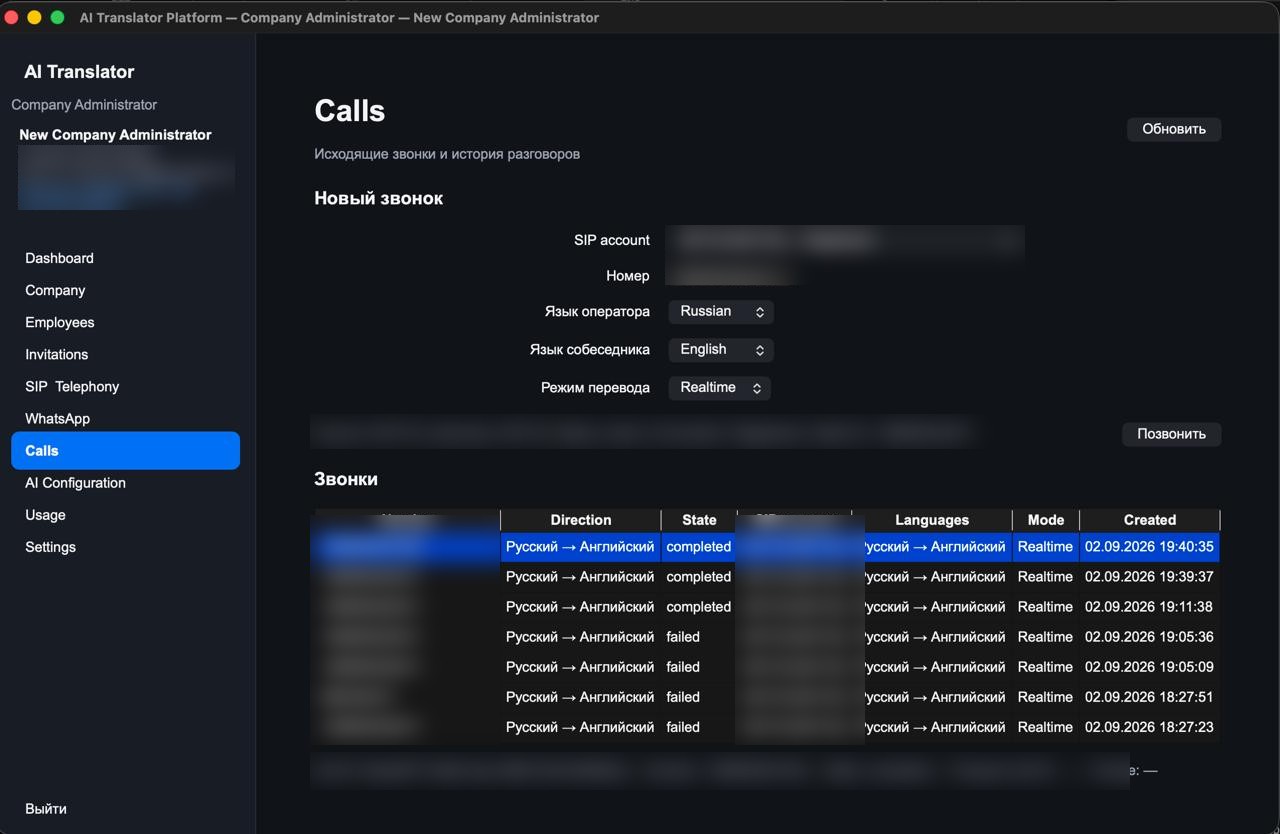
Operators can select a SIP account, choose agent and customer languages, use real-time translation mode and work with call history from one interface.
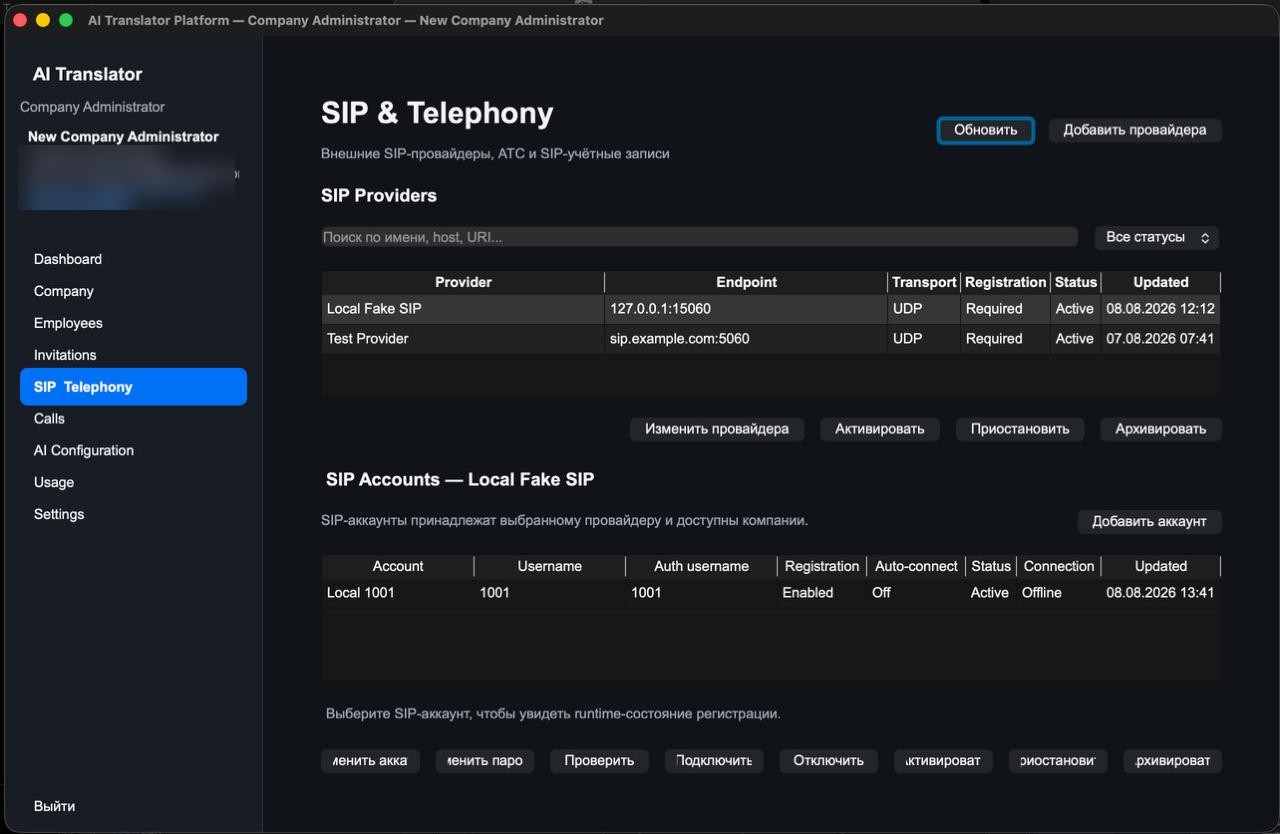
The administration layer manages SIP providers and accounts, registration behavior, runtime status and connection controls without tying the platform to one telecom vendor.
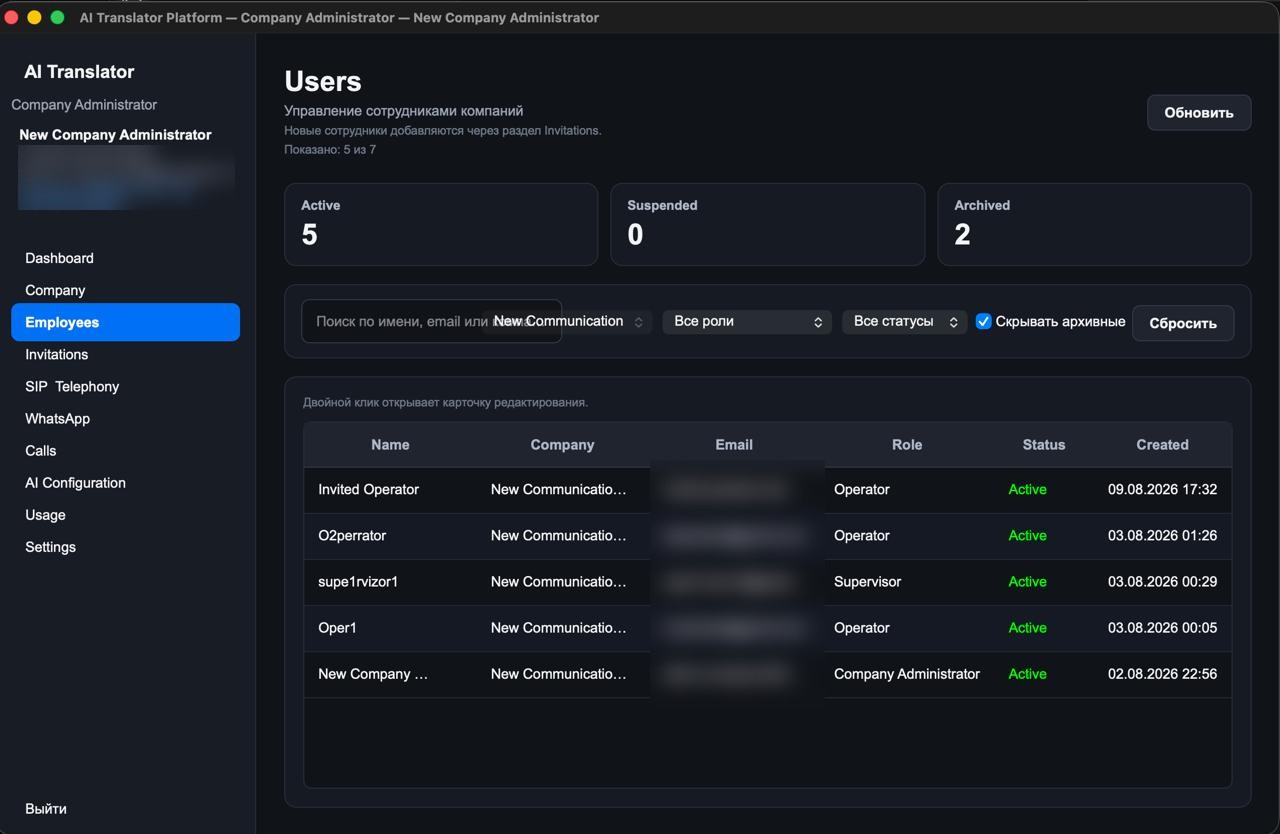
Company administrators can manage operators, supervisors and administrators with active, suspended and archived lifecycle states.
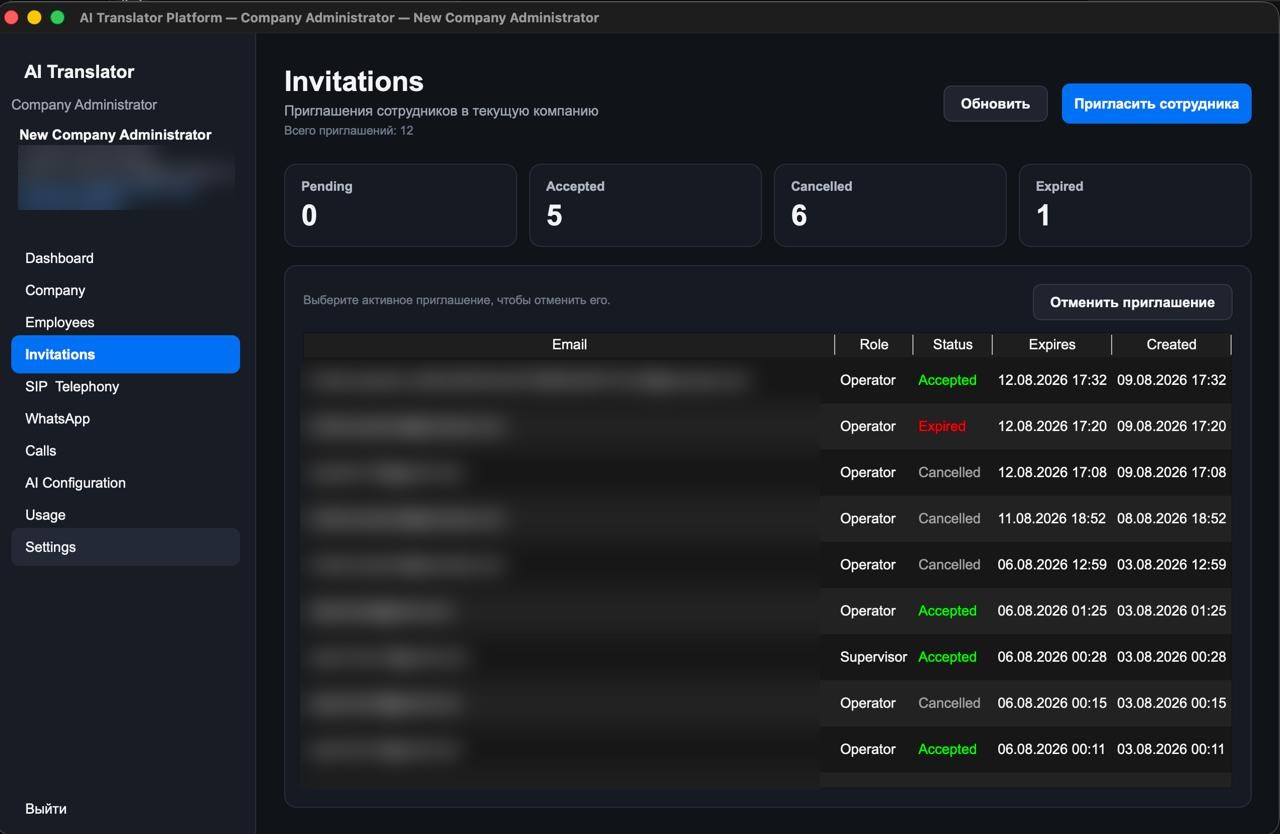
New employees are onboarded through role-based invitations with pending, accepted, cancelled and expired states.
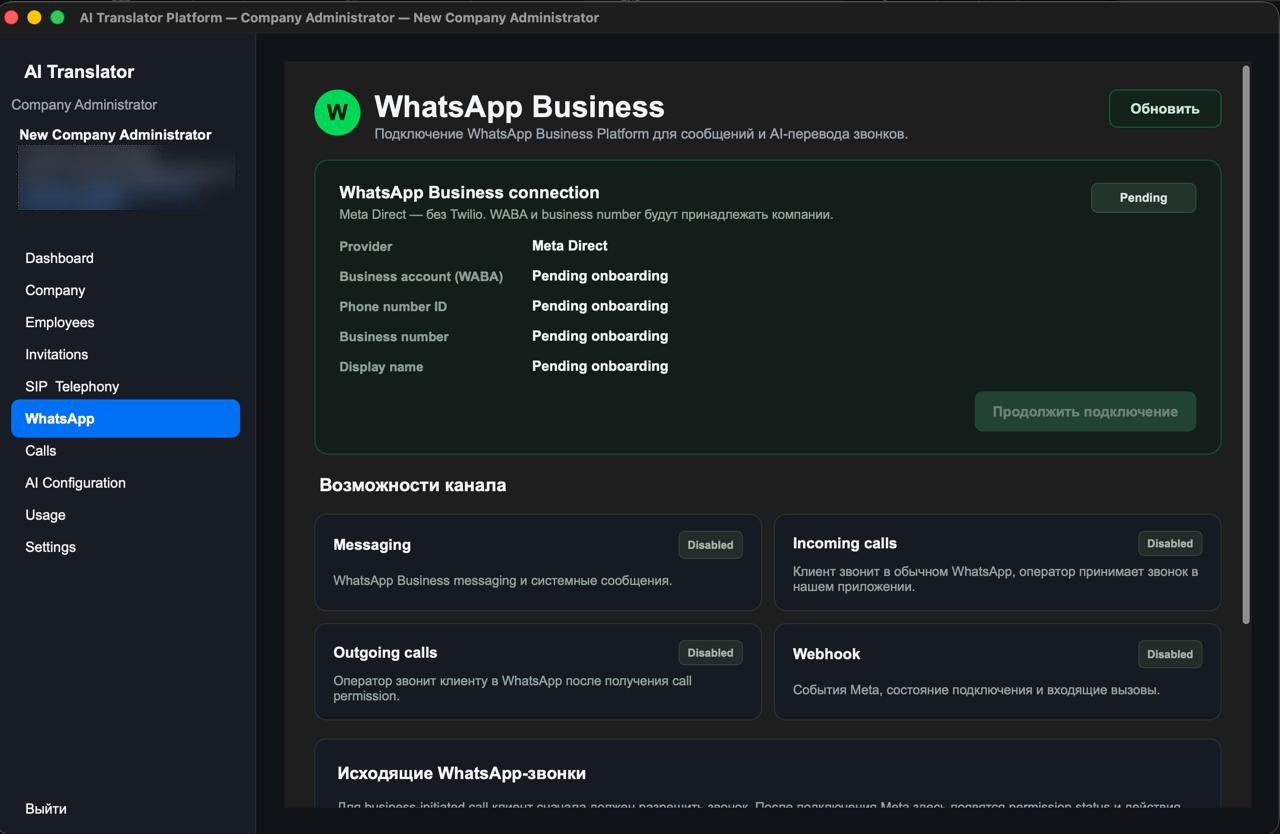
The platform includes a dedicated Meta/WhatsApp Business integration area covering onboarding, messaging, call capabilities and webhook state.
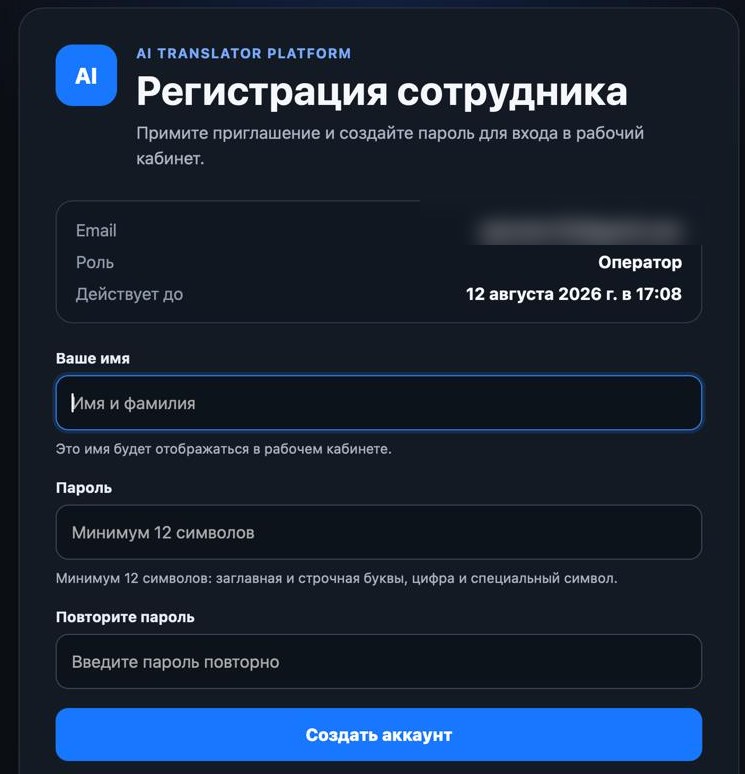
Invited team members can accept an invitation in the browser, create their account and then enter the appropriate desktop workspace.
The product is designed as a multi-role contact-center system rather than a single translation screen.
The current MVP establishes the core communication architecture. The roadmap below shows natural extensions of that foundation rather than functionality presented as already production-complete.
Add consent-based custom and cloned voices so translated speech can use an approved operator or brand voice, together with richer TTS controls and speaker adaptation.
Support multiple STT, translation, LLM and TTS engines and dynamically select them according to language, latency, quality requirements, customer plan and operating cost.
Evolve the real-time contact-center infrastructure toward high concurrency through distributed workers, queues, autoscaling, health monitoring, failover and systematic load testing.
Add a commercial SaaS layer with company plans, monthly or annual subscriptions, AI-minute allowances, usage-based billing, language and integration limits, and enterprise licensing.
Use the platform-level administrator workspace as a controlled environment where new AI models, telephony capabilities and integrations can be enabled and tested before selective or platform-wide rollout.
Expand the existing communication foundation toward unified Voice, WhatsApp, SMS, email and web chat, with AI voice agents, intelligent routing and CRM/CCaaS integrations.
Measure recognition, translation and speech latency and quality, compare model performance, detect problematic sessions and provide operational dashboards and alerts.
Extend supervisor workflows with live monitoring, conversation summaries, call scoring, sentiment signals, agent coaching and AI-assisted quality assurance.
Develop audit logs, SSO, granular permissions, data-retention controls and configurable white-label deployments for BPO, telecom and CCaaS partners.
The current product already brings together companies, users and roles, operator and administration workflows, SIP/PSTN telephony, real-time audio processing, speech recognition, AI translation, synthesized voice and communication integrations.
The next stage is an expansion of that foundation into a scalable commercial contact-center platform with subscriptions, multiple AI model tiers, custom voices, intelligent automation, advanced analytics, omnichannel communication and enterprise deployment capabilities.
The acquisition opportunity is not only the functionality already built — it is the architecture and development path behind it.
AI Translator Platform is currently an advanced MVP / pre-production system. It may be a fit for a strategic buyer that already has distribution, contact-center customers, telecom infrastructure or an established engineering and sales organization.
A potential acquisition can include the source code, application architecture, backend services, desktop application, SIP/PSTN implementation, AI speech pipeline, database structure, configuration templates, project assets and reasonable technical handover assistance, subject to the final agreement. Third-party accounts, API credentials, SIP accounts and paid service subscriptions are not included unless separately agreed.